Submission
Schedule
- 2026/2/2 (Mon): CMT submission system opens, Oral Presentation Track submissions open
- 2026/3/9 (Mon): Oral Presentation Track abstract deadline
- 2026/3/16 (Mon): Oral Presentation Track paper deadline
- 2026/5/25 (Mon): Poster & Demo Track submissions and Invited Talk recommendations open
- 2026/5/29 (Fri): Oral Presentation Track notification (tentative)
- 2026/6/22 (Mon): Camera-ready deadline (Oral Presentation Track, Poster Track, Demo Track), Invited Talk recommendation deadline
- 2026/8/3 (Mon) – 6 (Thu): MIRU Main Event
Submission Flowchart
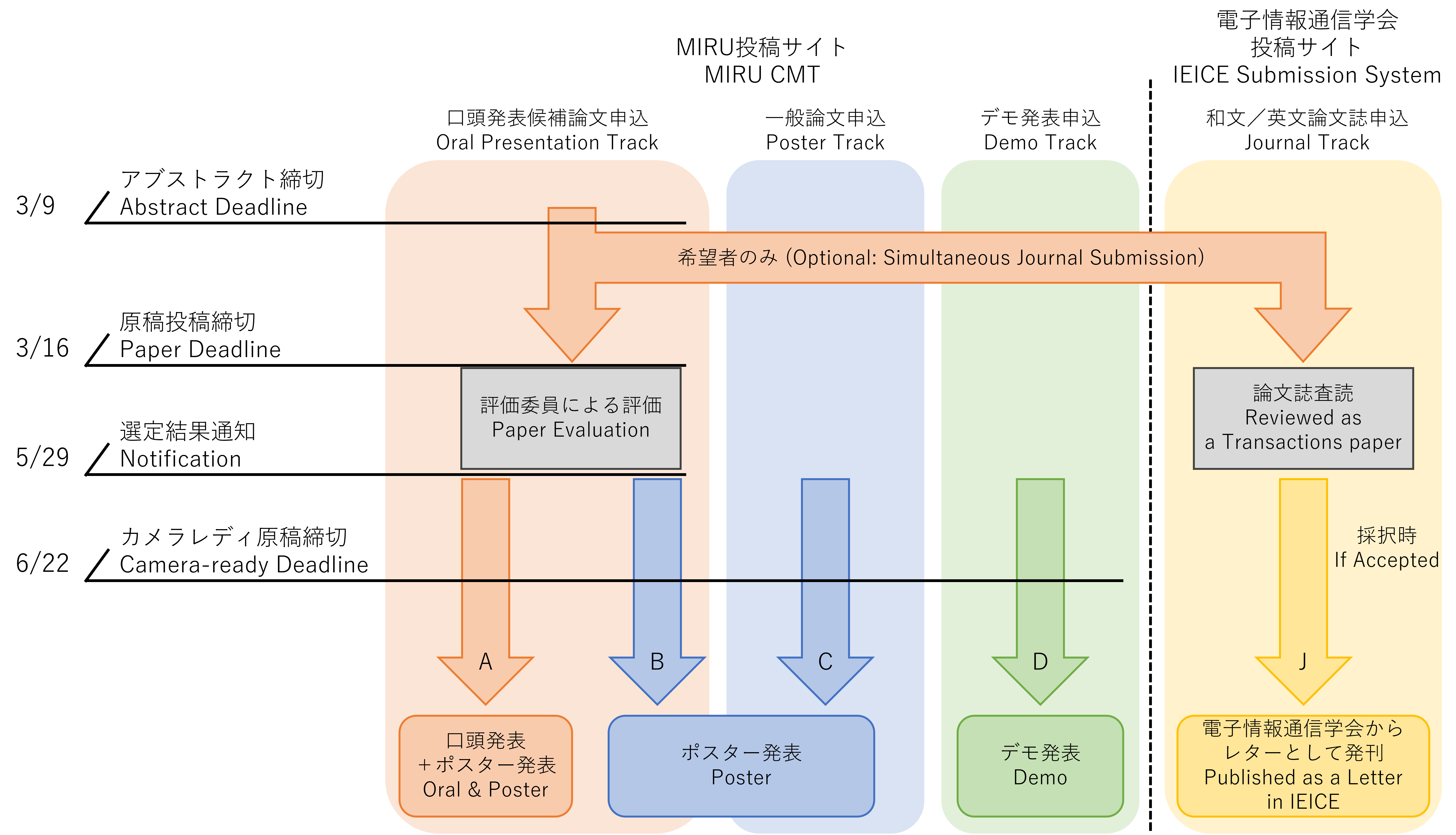
Submissions to the oral presentation track will be evaluated by the paper evaluation committee. Based on the results, it will be presented either in Track A, which has both oral and poster presentations, or in Track B, which is jointly presented with Track C as a poster presentation in an interactive session. The camera ready deadline for all tracks is 6/22.
If you submit to the oral presentation track and want the paper to be considered for the IEICE journal, please submit it through the IEICE website to the journal track. The evaluation process is the same as for MIRU2026. If it is judged as suitable for journal publication, it can be published in a cooperated IEICE journal (Letter). Note, that the review guidelines for MIRU2026 and IEICE Journals do not match, so they might yield different outcomes. In this case, authors are responsible for publication fees. For more details, please refer to the ISS Symposium and Transactions Concurrent Review System guidelines.
Review guidelines for IEICE Journals:
English: https://www.ieice.org/eng/shiori/page2_iss.html#7-1
Japanese: https://www.ieice.org/jpn/shiori/iss_5_1.html#5.1For poster track submissions without paper evaluations, please submit to Track C. You will be able to present your work as a poster in an interactive session. The submission deadline is 6/22.
In case you need a larger setup than a poster plus a laptop or tablet (e.g., cameras, sensors, VR setups, etc.), please submit your paper to the Track D as a demo presentation. For demo presentations, in addition to a poster panel, you can receive a desk and power supply. The submission deadline is 6/22.
Style Guidelines
- Write your manuscript in Japanese or English.
- Keep it within 4 pages without references.
- Include an abstract (up to 100 words in English or 200 characters in Japanese) on the first page.
- Include author names and their affiliations in the manuscript. The paper evaluations for the oral presentation track are single-blinded, meaning that evaluators will be able to see the author list.
- The authors may optionally submit supplementary materials such as videos, proofs, code, additional figures or tables, or more detailed analysis of experiments presented in the paper.
- The submitted manuscript and supplementary materials will be included in the MIRU Extended Abstracts as they are: for oral presentations, at the camera-ready submission, and for poster and demo presentations, at the paper submission.
- Note that, for papers considered for the oral presentation track, there is no guarantee that the contents of the supplementary materials will be reflected in the evaluation.
Template
Use the template provided below. It changed since last year, so make sure to download the newest version. Both LaTeX and Word support Japanese and English.
Miscellaneous
- The copyright of submitted manuscripts will be retained with the author(s). The MIRU Extended Abstracts will only be made available to MIRU participants during the event via a password-protected download link on the website.
- You cannot make any changes to the title or author list after the camera ready deadline.
- With reference to the Charter of Ethics of IEICE and the Code of Ethics of the IPSJ, please be considerate of those around you, and refrain from explicit sexual or violent content as well as excessive promotion of your company’s products.
Dual Submission Guidelines
| Oral Presentation Track | Poster Track | ||
|---|---|---|---|
| At MIRU2026 submission deadline, the work is accepted or published | Another peer-reviewed venue | × | ○ |
| Non-peer reviewed venue (Domestic event, arXiv etc.) | ○ | ○ | |
| A work is currently under review at another venue | ○ | ○ | |
| No related presentations or publications | ○ | ○ | |
(The points below are regarding oral presentation track submissions.)
- As MIRU is a forum to exchange of “new ideas” that do not reach the level for journal or international conference submission yet, please refrain from submitting work which is already published in a peer-reviewed journal or conference proceedings.
- The MIRU2026 Extended Abstracts will not be made publicly available. However, if you use parts of a paper, which are submitted to international conferences or journals, make sure to still comply with their submission guidelines.
【For reference】In CVPR2026, submissions that are no more than 4 pages (excluding references) do not count as dual submissions.
Submission Link
Please use the CMT portal (https://cmt3.research.microsoft.com/MIRU2026) to submit your manuscript. Please refer to the slides below for detailed instructions.
Oral presentation track
Submission Areas
Area A: Geometric analysis, optical analysis, 3D analysis
- Camera, geometry, and photometry
- Computational imaging
- Physics-based vision and graphics
- Registration, pose estimation, and tracking
- 3D from a single image and shape-from-x
- 3D shape modeling, processing, and synthesis
- 3D from multi-view and sensors
Area B: Pattern recognition, machine learning, deep learning
- Datasets, training, and evaluation
- Deep learning (architectures, generative models, deep reinforcement learning, geometric deep learning, etc.)
- General machine learning (active learning, clustering, online learning, ranking, reinforcement learning, un/semi/self-supervised learning, time series analysis, etc.)
- Learning theory (Bayesian methods, graphical models, statistical learning theory, etc.)
- Optimization (convex / non-convex optimization, matrix / tensor methods, stochastic, online, non-smooth, composite, etc.)
- Representation learning and feature extraction
- Transfer, low-shot, continual, and long-tail learning
- Trustworthy machine learning (accountability, causality, fairness, privacy, robustness, etc.)
Area C: Image/video/multimedia processing
- Action and event understanding
- Categorization, segmentation, and shape analysis
- Image / video analysis, retrieval, and understanding
- Image / video synthesis
- Low-level vision and signal processing
- Multimedia
- Object detection, matching, and tracking
- Vision and language
Area D: Application
- Autonomous driving and ITS
- Biometrics
- Cloud, web, and social media
- Document analysis and understanding
- Efficient, scalable, and realtime processing
- Human sensing (faces, gestures, pose, shape, etc.)
- Industry and manufacturing
- Life (sports, agriculture / forestry / fishery, civil engineering, commerce, fashion, food, home, etc.)
- Medical / biological vision and cell microscopy
- Robot vision and embodied vision
- Scene analysis and understanding
- XR and HCI
Acknowledgement
The Microsoft CMT service was used for managing the peer-reviewing process for this conference. This service was provided for free by Microsoft and they bore all expenses, including costs for Azure cloud services as well as for software development and support.